
Call (734) 769-2909

§ 01Guide

The Complete Guide to Eye Health & Choosing an Optometrist

Choosing an eye doctor and understanding your own eye health are two skills almost no one is taught. This guide walks through both plainly — how often you actually need an exam, who does what among optometrists, ophthalmologists, and opticians, how to read a prescription, the myopia question every parent should ask, and how insurance actually gets billed. None of it is medical advice for your specific eyes; it’s the map we wish every new patient had before their first visit.

Start with your own risk profile, not a search engine

Typing “best eye doctor near me” skips a step that actually narrows the search: knowing what you’re looking for. A twenty-five-year-old with no family history of eye disease and no complaints needs a different kind of visit than a sixty-year-old with diabetes, or a seven-year-old whose teacher just mentioned she squints at the board. Before you book anywhere, take thirty seconds to place yourself:

  • No symptoms, no family history — you likely need a routine comprehensive exam on a normal interval.
  • A family history of glaucoma, macular degeneration, or diabetic eye disease — you need a practice with imaging on site, not just a chart on the wall.
  • A change you’ve noticed — new floaters, headaches, or blur — deserves a visit now, not at your next scheduled slot.

The right practice for you is the one whose equipment and appointment length actually match that profile — not just the one with the shortest wait.

How often you actually need an exam (it’s not always “every year”)

“Once a year” is a reasonable default, but it isn’t a rule. Healthy adults with no symptoms and a stable prescription can often go a year to two between visits; contact lens wearers, people over 60, and anyone with diabetes are generally better served checking in every twelve months, since several of the conditions eye doctors watch for — glaucoma, diabetic retinopathy, macular changes — develop with few or no symptoms until they’ve already taken a toll.

Children are the exception in the other direction: eyes change quickly while they grow, and an undiagnosed prescription can quietly affect how a child reads, learns, and even behaves in a classroom. Annual exams from age four on, sooner if a teacher or parent notices something, are the safer default.

Optometrist, ophthalmologist, or optician — who does what

The three titles get used almost interchangeably in conversation, but they aren’t the same license. An optometrist (OD) is a doctor of optometry — trained and licensed to examine eyes, diagnose and manage most eye diseases, prescribe glasses and contacts, and treat many conditions medically. An ophthalmologist (MD) is a physician who can do all of that and also perform eye surgery — cataract removal, retinal procedures, and the like. An optician is a technician trained to fit and dispense glasses and sometimes contacts from a prescription, but does not examine eyes or diagnose.

For the vast majority of visits — a routine exam, a new prescription, a contact lens fitting, or managing a chronic condition like dry eye or glaucoma — an optometrist is the right first call. If a condition needs surgery, a good optometrist will tell you plainly and refer you to an ophthalmologist rather than sit on it.

What a real comprehensive exam includes (and what a 10-minute one skips)

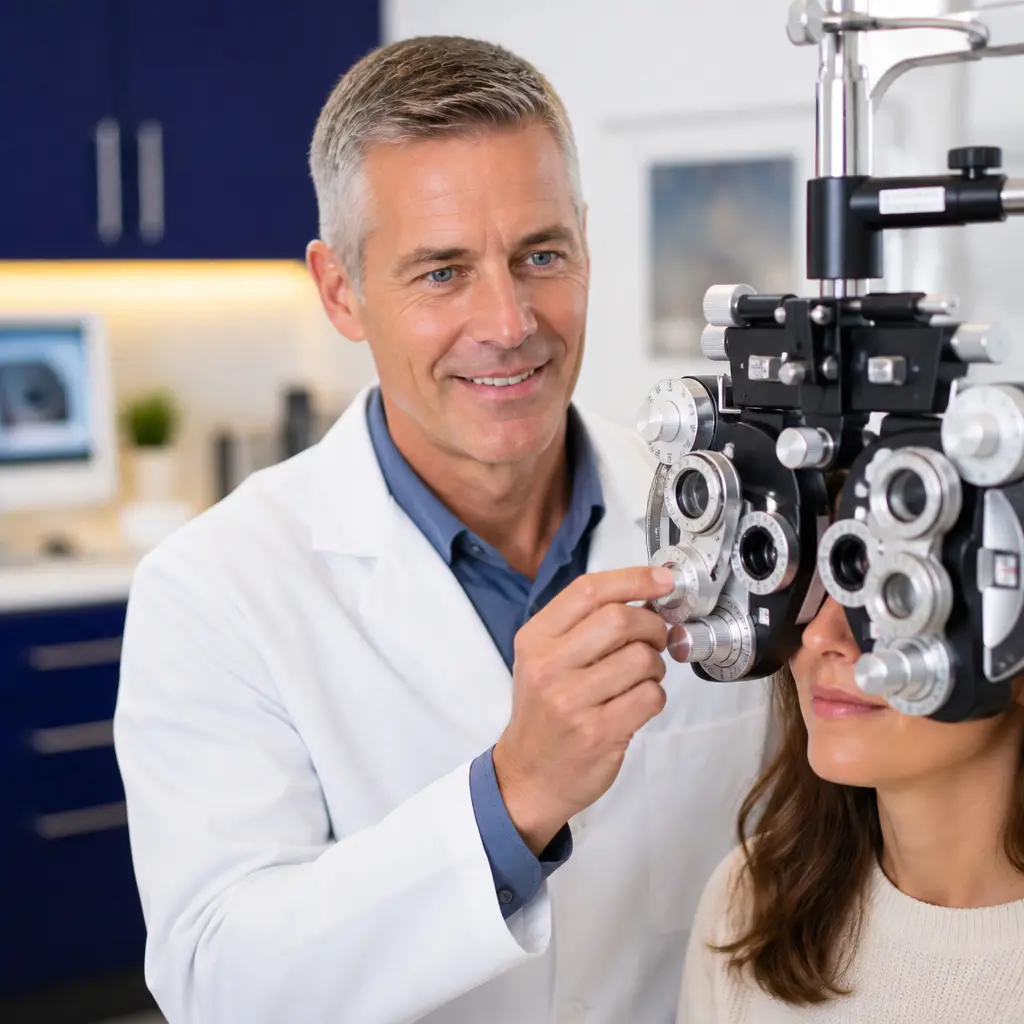
Not every “eye exam” is the same length or depth, and the difference matters more than most patients realize. A rushed refraction — the part that generates a glasses prescription — takes only a few minutes and tells you almost nothing about the health of the eye itself. A genuinely comprehensive exam adds:

  • Binocular vision and eye-teaming testing, not just single-eye acuity
  • Intraocular pressure measurement, a first screen for glaucoma risk
  • A dilated or wide-field retinal exam to see the back of the eye
  • Time for the doctor to actually explain what they found

If a practice’s exam slot is built for volume rather than time, the shortcuts tend to land exactly here — the parts that don’t generate a prescription but do catch disease early. Ask how long the appointment is actually scheduled for before you book.

Reading a contact lens or glasses prescription before you buy anything

A prescription is yours the moment the exam ends, no purchase required — most states require this by law, and any practice that makes filling it elsewhere awkward is a signal worth noticing. Before you fill one anywhere, though, it helps to know what you’re looking at. A glasses prescription lists sphere (near/farsightedness), cylinder and axis (astigmatism), and sometimes add power (for reading). A contact lens prescription is a separate document — it specifies the brand, base curve, and diameter of a lens that’s been fitted to your eye, not just corrected to your vision, which is why a glasses prescription can’t be used to order contacts.

Contact lens prescriptions also expire faster in practice, since the fit of a lens on the eye’s surface can change even when the vision itself hasn’t — one more reason a fitting exam, not just a refraction, matters for lens wearers.

Kids' eyes: when to start, and the myopia question every parent should ask

Most children should have their first comprehensive eye exam around age three to five, and annually once they’re in school — vision problems are a common, under-diagnosed cause of reading and behavior struggles that get blamed on other things first. The exam itself doesn’t require a child to read letters; picture charts and instruments do most of the work for kids too young to say what they see clearly.

The other question worth asking, especially if a parent wore glasses young: is my child’s nearsightedness (myopia) getting worse faster than expected, and is anything being done to slow it? Myopia that progresses quickly in childhood raises long-term risk for other eye conditions in adulthood, and treatments like specialty contact lenses, orthokeratology, and low-dose atropine drops can measurably slow that progression when started early. Not every practice offers or even discusses this — it’s a fair, specific question to ask when you call.

Insurance, vision plans, and self-pay — what actually gets billed where

Vision insurance and medical insurance are not the same thing, and the confusion causes more billing surprises than almost anything else in eye care. A routine, symptom-free comprehensive exam is typically billed to vision insurance (the kind that also covers a glasses or contacts allowance). An exam prompted by a medical symptom — a red eye, sudden floaters, diabetes monitoring, glaucoma follow-up — is typically billed to medical insurance instead, even if it happens at the same office on the same day a routine visit would.

A practice that verifies your specific benefits before you arrive, rather than after, is doing you a real favor: you’ll know your out-of-pocket cost before you’re in the chair, not on the invoice afterward. If self-pay makes more sense for your situation, ask for exact pricing up front — a practice with nothing to hide will give you a number, not a range.

Red flags that mean “call today,” not “wait for the annual”

Most eye care is scheduled, not urgent — but a short list of symptoms deserves a same-day call rather than a spot on next month’s calendar:

  • A sudden increase in floaters or flashes of light
  • A curtain or shadow moving across part of your vision
  • Sudden pain, redness, or light sensitivity in one eye
  • Any vision loss that comes on suddenly, even briefly
  • An eye injury involving a chemical, sharp object, or significant impact

None of these are meant to cause alarm on their own — most turn out to be manageable — but they’re the symptoms where a same-day evaluation genuinely changes outcomes. A practice that holds real same-day slots for exactly this, rather than routing every call to “the next opening,” is worth knowing before you need it.

Choosing well in Ann Arbor: what a decade of return visits usually means

Anyone can advertise “comprehensive” exams; the useful signal is what patients do after the first visit. In a market with as many optical chains as Ann Arbor’s, the practices that keep families for a decade tend to share the same few traits: appointments long enough to actually explain a finding, equipment that catches disease early rather than just measuring for glasses, and a doctor who remembers the visit before last without checking notes first.

As you compare practices, weigh the signs that tend to hold up against the ones that don’t:

  • Good signs: a real appointment length quoted up front, in-house imaging rather than "we’ll refer you," and a prescription handed over freely at the end of the visit.
  • Weaker signs: pressure to buy glasses on the spot, vague answers about how long the exam actually runs, and reluctance to quote a self-pay price before you ask twice.

The first visit will usually tell you which kind of practice you’ve found — and that, more than any single review, is how to choose one in Ann Arbor.

§ 13Last call13 / 13

See the difference a real exam makes

Book online in under a minute — or call and a human at our Ann Arbor front desk will find you a time this week.

Open Monday 8:00 AM–6:00 PM · 1565 Eastover Pl, Ann Arbor